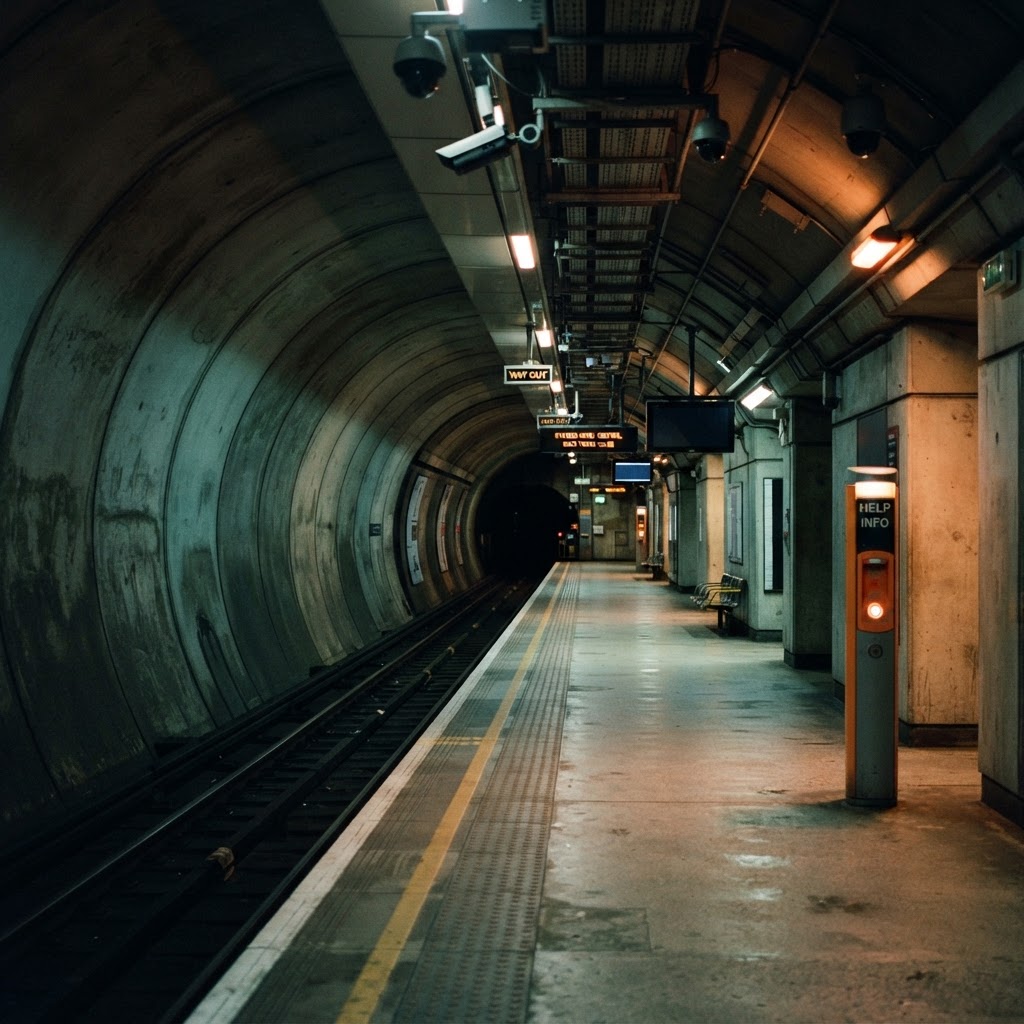
A minute at the boom is not a $2.7 billion problem
CRL's opening week put rail boardings back in the pre-COVID daily band, but the $2.7 billion crossing-removal programme rests on a BCR of 1.0 and a timetable the network is not yet running. A one-minute boom is a red light with a bell; nine-car platforms and southern paths are the cheaper capacity.
Auckland opened City Rail Link on 13 September 2026 and immediately started talking as if the old suburban streets had become a metro. They have not. The working timetable is six trains an hour on the South City line at peak, six to eight on the East–West, two on Onehunga West. Almost every train is six cars. The fleet is ninety-five three-car units after the last twenty-three arrived in February. Last financial year rail carried 14.4 million people. All public transport was 92.0 million; the bus did 72.6 million of that, the ferry 5.0 million. Rail was 16 percent of boardings. The NX1 busway route alone did 4.7 million. Opening week hit 528,007 rail boardings against 325,203 the week before, beating the March 2019 week of 504,380. Thursday’s card count was 85,289. Door counters were quoted higher. The pre-COVID single day record was 87,092 on 6 March 2019. You are back in that daily band. You are not through it. AT’s published rail targets are 17.6 million this financial year, 22.0 million the year after, 23.3 million in 2028/29. The modal forecasts do not even add to the headline 103.8 million public-transport target; a lump of “unallocated growth” was left sitting in the table. Treat the first week as a new city-centre catch plus curiosity. Do not annualise it into a civil programme.
The Auckland Rail Programme Business Case is the document that still wants to spend as if you had. Whole-of-programme capital sits at $21.2 billion P50 and $28.3 billion P95. The benefit–cost ratio is 1.0 without wider economic benefits and 1.2 with them. That is a coin toss with a press release. Inside AT’s thirty-year rail split, $2.7 billion is crossing removal, $2.0 billion station upgrades, $2.0 billion fleet, depots and stabling. Western Line replacements have been discussed at $2.5 to $3.5 billion over 10 to 30 years. Takaanini, the one cluster that actually sits on freight plus metro plus a record, was $436 million P50 and $647 million P95, $144 million of it property. The Eastern Line was built later and is already largely clear of crossings. The south has the third main and Pukekohe electrification. New stations at Drury and Paerātā opened in August 2026; Ngākōroa is due in 2027. Those are the places where the network is being lengthened. The west is where the brochure wants to bury streets.
The legal machinery around that spend is not optional colour. The Land Transport Management Act requires a Rail Network Investment Programme, ministerial approval, and NZTA monitoring. KiwiRail is still an SOE under the 1986 Act: commercial, not a municipal earthworks agency. The Railways Act 2005 s7 duty is risk reduced so far as is reasonably practicable. Section 81 is notices and warning devices, agreed in writing with the road authority, not a mandate to grade-separate. LCSIA and ALCAM sit under the Level Crossing Risk Management Guide v6. The Government Policy Statement on land transport is written around productivity and freight. Treasury’s Better Business Cases model still wants a strategic case, an economic case, a commercial case, a financial case and a management case that survive contact with the timetable you are running, not the one on a 2045 slide. A resilience programme sitting beside this work came in at about $1.2 billion whole-of-life with a BCR of 2.7 to 3.5. That is what a constrained dollar looks like when it is aimed at a real failure mode. Crossing removal at BCR 1.0 is not that.
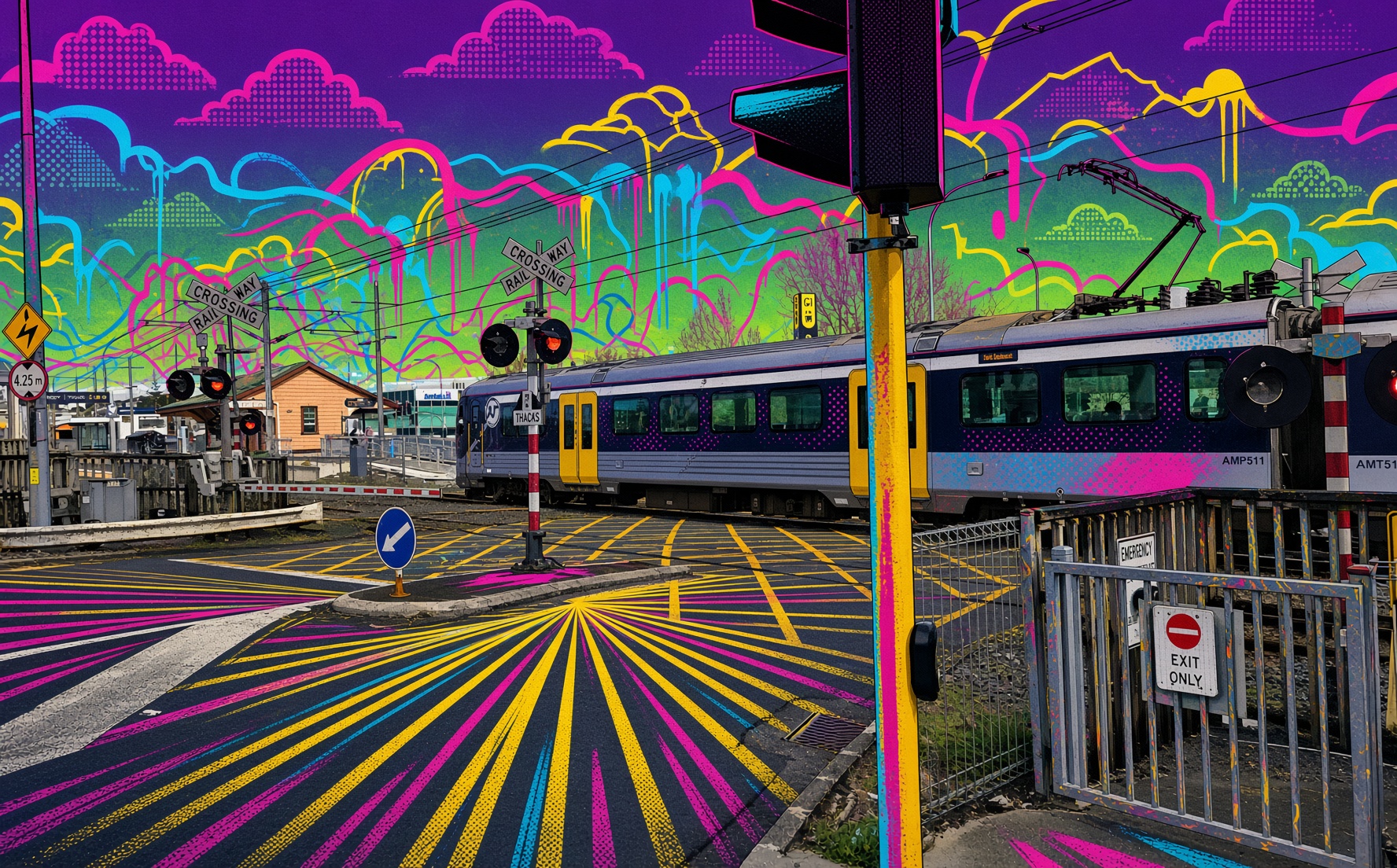
Auckland Transport’s public line has been that crossings must come out before frequencies can rise, because more trains mean longer delays and more risk-taking. The timing on the ground does not support treating every remaining western crossing as that problem. KiwiRail’s Sarawia Street note puts a single train at about one minute of arms-down. Lights, booms drop, train clears, alarms off within five seconds of the last axle, arms up. Fruitvale Road was designed for 24 seconds of warning at 65 km/h. Barriers started down five seconds after the lights and were horizontal about seven seconds later. Where traffic signals are tied in, the road authority typically wants 15 to 18 seconds of pre-emption before the railway alarms start, so a driver never sees a green into a falling boom. Predictors compute warning from approach speed rather than a fixed track circuit; through trains are told not to accelerate once they are about 500 metres out. If a second train arrives before the crossing has been open 15 seconds, the arms stay down. That last rule, not the length of the train, is what turns a red-light event into a lockout.
Auckland already asks motorists to wait a minute. Arterial signal cycles of 120 to 140 seconds are ordinary. Lake Road has run 130–135 seconds in the peaks. Side roads often get 15–20 percent of the cycle. Miss the phase and you sit most of two minutes. Pedestrians in this city have been measured waiting fifty seconds and more. A 50–80 second hold at a boom is the same class of delay as the next intersection. It is not a collapsed suburb.
Lengthening the train barely changes that minute. A six-car AM set is about 144 metres, a nine-car about 216. At 70 km/h the extra three cars add roughly four seconds on the deck. The rest is warning time and steel moving. Six trains an hour, one minute each, no bunching: about 10 percent of the hour. Eight an hour is still a long SCATS cycle. Twelve movements across two tracks start to look like old Sarawia if paths bunch. Sarawia itself, in the pre-CRL note, had 38 trains in two peak hours, arms down 37 minutes, 33 separate closures, about 30 percent of the peak, because following trains were not given a quarter-minute of open road. The number that actually breaks the street is in the Takaanini modelling: at a forecast 24 trains an hour, Spartan Road spent 44 minutes of the morning peak hour with the arms down. Walters Road showed peak vehicle delays up to four minutes. That is when people drive around. Day-one CRL is not 24 tph on Baldwin Avenue. The west is being asked to pay for a lockout it does not have.
Frequency is not created by an underpass. It is created by paths, power, signalling, dwell, freight windows and whether the published train leaves. The January 2026 simulation with 84 trains failed on network congestion. Testing through the tunnels went as high as 16 to 18 trains an hour per direction; Westfield was stressed at 20. Opening day is not that. Off-peak on the new map is still four an hour on the main lines, fifteen-minute clockface. Peak extra paths on the west were planned in the peak direction only, and the peak window itself was shortened in the draft patterns. A cancelled six-car train is a total loss of frequency. Opening-week punctuality climbed toward 99 percent by Thursday. That is the frequency programme that does not need a designation.
The capacity lever that does sit in the same budget, and loses the argument every time, is train length. Three more cars on a path you already own is 50 percent more seats. The Programme Business Case only needed targeted nine-car southern expresses this side of 2051. Network-wide nine-car sat after that unless growth exploded. The tunnels and Te Waihorotiu, Karanga-a-Hape and Maungawhau are already built to nine cars. Most surface platforms are not. The new southern stations were poured at 150 metres for six cars with 75 metres left in the designation for later. Every month a six-car set runs through a nine-car underground station is capacity already purchased, sitting idle, while the largest AT rail line item goes on bridges. Station lengthening happens inside the rail corridor. It does not require Fast-track on twenty-one high streets or a ten-year argument about whether a local road remains a local road.
Keeping crossings is not a death wish. It is a statement about severance and proportionality. A grade-separated street that no longer meets the next street is a new barrier for people who were not in the economic model. Walking and cycling catchments shrink. Local retail on both sides of the cut loses the incidental crossing traffic. Property take at Takaanini scale, multiplied across the west, is a social cost the BCR at 1.0 cannot carry. SFAIRP is a comparison of options, including doing less. Section 81 already assumes warning devices, not trenches, as the default tool.
The cheaper stack is not theoretical. Corridor consolidation is the first test in American and Australian guidance: daily vehicles, extra travel if the crossing closes, trains per day. Close the quiet one. Send the traffic to the next protected crossing or the overbridge already in the suburb. Four-quad gates and channelisation on two-quad gates cut drive-around. US work put that reduction around three-quarters. Longer arms, medians, sightlines, lighting and cameras sit in the tens of millions. Britain’s MCB-OD and Japan’s obstacle detection cut boom time by holding the train if the deck is blocked rather than holding the town because a path is late. JR East has published closure-time reductions in the 20 to 50 percent range on detection sites. Low-cost active warning on quiet rural or industrial crossings is another rung before anyone reaches for a road-over-rail structure. Wairarapa has already closed and consolidated on a small scale. Auckland’s own western engagement has already said full vehicle grade-separation of the remaining sites is likely unaffordable. Record that as the plan.
Takaanini remains the site that passes the filter. Freight and metro share the deck. The 2031 modelling showed a street closed more than it is open. Spend there. Do not photocopy the same project across Fruitvale, Glen Eden, Morningside and Baldwin Avenue because AT’s website still says frequencies will double “in some areas” and therefore every interface must go.
Package integrity is the usual reply from inside the programme: the benefits only appear if you buy the whole stack. That is true only if the stack is the constraint. On the timetable in the app the constraints are southern paths, reliability, power and platform length. Wider economic benefits were what moved the BCR from 1.0 to 1.2. Strip them and you are being asked to commit P95 capital near $28 billion on a programme that does not clear a basic economic test. Optimism bias is why those numbers exist in a range. RNIP variations already show how fast a three-year rail envelope moves when something more urgent appears. A $200 million variation in a statutory programme is a reminder that the next decade will not be spent only on western bridges.
The rule that can be put to a board or a minister is short. Run LCSIA against the operating timetable, not the 2045 slide. If upgrade-in-place or consolidation meets SFAIRP, stop. Put the next capital into southern platform extensions, the paths the January simulation said you do not have, and the reliability that turns six published trains into six actual trains. Wait for three to six months of HOP and contactless data before anyone reopens the thirty-year stack off one record week. If the next dollar does not add a reliable path, a longer train, or a documented failure at six to eight trains an hour, it waits.
That is the pragmatic strategy. It costs little relative to $2.7 billion. It uses the nine-car holes already dug under the city. It treats a one-minute boom as what it is: a red light with a bell, at frequencies that leave the street open most of the hour. The safety and efficiency labels on the crossing programme do not survive that timing. Gates and medians deal with the remaining risk at today’s service. Nine-car platforms deal with the seats. Bridges deal with a railway Auckland is not yet running.
Join the discussion
Community members are invited to add perspective, evidence, or a sharp question. Be specific and keep it civil.
No comments yet. Be the first to weigh in.