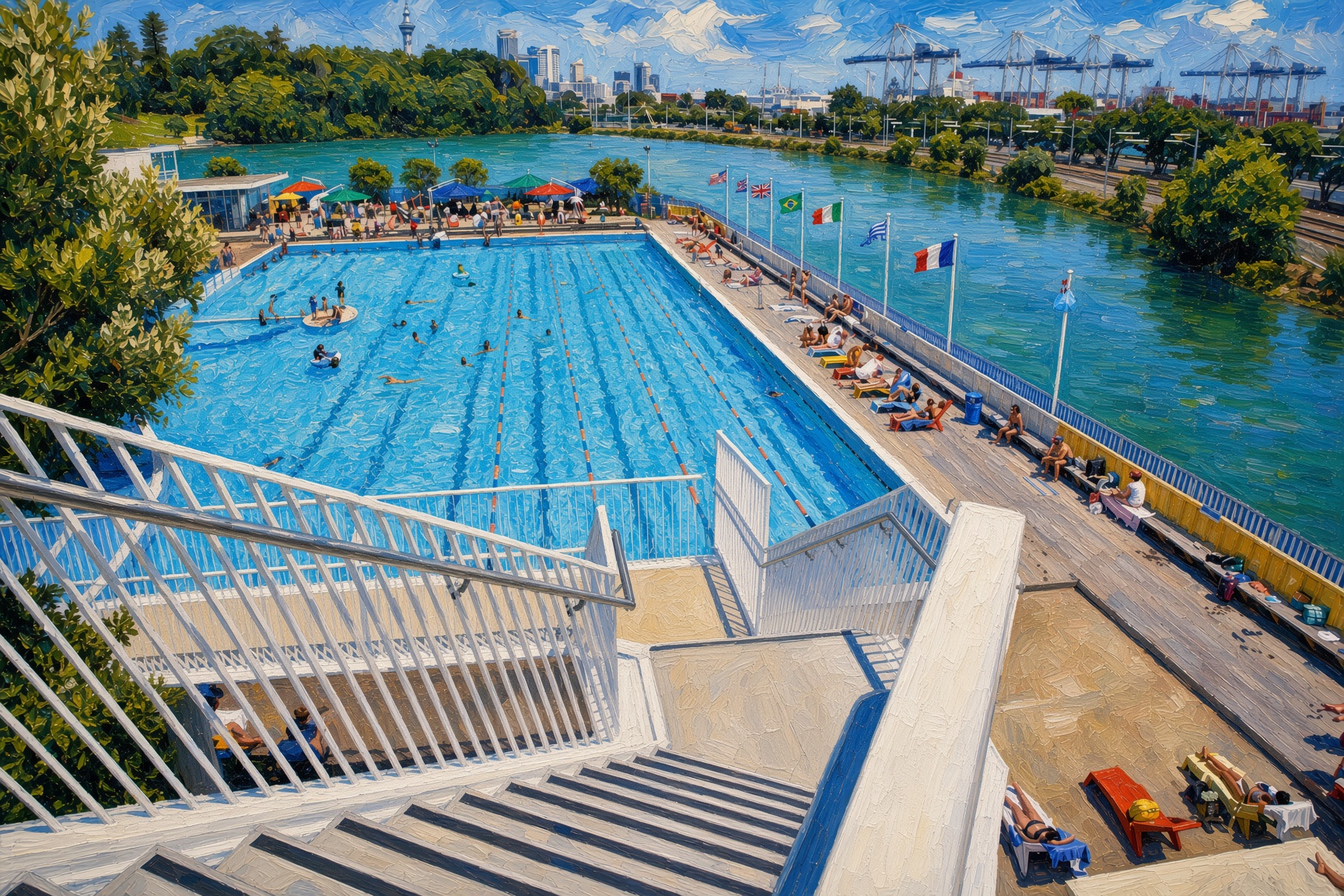
Don't try to make a happy child happier
Auckland Council should set the environment for community — parks, halls, libraries, pools, simple hire — and stop midwifing belonging with contestable grants. Option B for the Long-term Plan 2027–37.
City Builders Association · September 2026
For the public record and Long-term Plan 2027–37
A child who is already playing does not need an official to improve the game. The interruption is not kindness. It is a theory of the adult: that joy is incomplete until it has been funded, facilitated, and counted. Auckland Council has built a large part of its “community” activity on that theory. This essay is the case for stopping.
The argument is not that parks should close or that libraries should go dark. Those things are the ground the child is standing on. The argument is that council cannot manufacture belonging with a grants portal, and that ratepayers have been asked to pay for the attempt without being shown whether it worked.
What community already is
Aucklanders already form community. They do it in clubs, churches, marae, codes, residences, workplaces, and on the same street two nights running. They do it badly sometimes and well sometimes. They do it without a local-board work programme. That is not a romantic claim. It is the ordinary fact that makes a city livable.
When council arrives with a contestable round for “connection” or “thriving,” it does not discover a vacuum. It discovers people who can write applications and people who cannot. It selects the first group. It then reports the number of partners supported as if that were the same thing as neighbourhoods holding together. It is not.
The legal purpose of local government in New Zealand is democratic decision-making and the promotion of wellbeing. Promotion is not possession. The Local Government Act does not require a midwife unit. It requires elected people to choose activities, fund them in a Long-term Plan, and tell the truth about performance. Council may keep a hall open. It is not required to run the conversation that happens inside it.
The theory council is running
Since amalgamation, and especially since the Empowered Communities language of the last decade, Auckland Council has treated community as something that must be delivered. Grants programmes, regional “thriving” funds, facilitators, activations, and partner counts are the tools. Local boards live inside the ritual: adopt a grants programme in April, receive more applications than money in September, part-fund the plausible ones, ask for an accountability form.
The amounts look small beside transport. They are not small as a habit. Regional contestable pots other than sports-facility capital ran at about $4.6 million in 2024/25. Local boards put six-figure sums into their own rounds — a quarter of a million dollars in some areas. Administration sits on top. Fairer funding then added more operating money to boards. Unless that money is locked to assets and access, it will become more of the same ritual.
What is missing is the only question that matters to a ratepayer: did community form that would not have formed anyway, and was the net effect worth the interruption? Council reports outputs. It does not report that net. Weak outcome measurement on contestable grants is not a footnote. It is the sound of a council that cannot tell whether the midwife helped.
Three options — only one is a position
City Builders Association puts civic questions as options so a vote can be recorded. Community policy is no different.
Option A — Midwife. Council delivers belonging. It funds programmes, counts partners, and treats an application as evidence of need. This is the current default. It selects grant-writers. It cannot show net community. Reject it.
Option B — Platform First. Council keeps the ground usable and the door unlocked. Parks, toilets, light, libraries, pools, halls that pass a utilisation test, occupancy leases for groups that actually occupy space, and rules simple enough that a neighbour can book a room on Tuesday. Community forms itself. Adopt it.
Option C — Hybrid. Fairer funding plus empowerment language plus “better accountability.” This is Option A that refuses to choose. It is how the spend survives a critique. Reject it.
Mixing the options is how the inner council remains unchanged. A refresh of empowered communities with tighter forms is not a decision. It is a delay.
What “set the environment” means
Environment is not a metaphor. It is a list.
Keep the lights on in places people already use. Publish whether those places are used. Fix the roof before you fund the workshop. Price hire so peak time is not a hidden subsidy and off-peak community use is still possible. Shorten the path from “we need the room” to “you have the room.” Keep a permit for scale and commercial occupation; stop treating a hundred neighbours as an event production. Occupancy guidelines already exist — exclusive use should sit on a lease, not on a grant round. Capital that fills a real gap in the sports and recreation network is environment. A salary for a connection officer is not.
The savings in this shift are real and they are not the whole Community line. Annual Plan Community operating spend is in the order of $865 million. Most of that is plant. Anyone who claims the entire line is waste is not doing this work. The cuttable layer is the midwife — soft grants, facilitation, council-as-programmer — and the dead-asset layer: halls held open so a programme has somewhere to sit. Name eight to ten million a year from the documented grant pots before you invent a larger number. Demand utilisation by venue before you claim the larger prize. Apply what you save to used-asset backlog, then to rates. Recycle nothing into a smarter facilitator.
The objection, and why it fails
The objection will be equity. It will say that cutting grants abandons poor neighbourhoods. That is a category error. A neighbourhood with less money needs a working hall, a lit park, a pool that opens, and a booking system that does not require a professional applicant. It does not need a $3,000 workshop more than it needs the roof. Platform First spends first on the used buildings in those places. It stops paying for the appearance of care.
The second objection will be that council has a wellbeing duty. It does. Duty is not a blank cheque for any activity that uses the word. Elected members choose. They can choose plant. They can choose to stop interrupting association that was already happening.
The third objection will be measurement: “we will improve accountability.” Accountability for a thing that should not be purchased is still a purchase. Count hours open, condition of used assets, booked hours against available hours, days to confirm a hire, days to permit a small gathering. Stop counting partners supported.
What this foundation requires next
This essay is not the implementation plan. It is the position the plan stands on.
Budget and Performance should instruct a sixty-day paper: Community operating spend split into plant and programme; every contestable pot; the staff cost of the grants machine; utilisation by venue for two years. The local-board funding review for the 2027–37 Long-term Plan should lock fairer-funding dollars off soft grants. The Long-term Plan consultation document should print Option B as a choice, not a paragraph inside wellbeing. Local boards that are willing should set contestable community grants to zero and raise hire recovery at peak. Community Committee can then be asked to make remaining grants capital-only. Asking that committee to invent the doctrine first is asking the midwife to design her redundancy.
The rates cap will eventually force a ranking. Write the ranking now: discretionary community programme first, used platform last. If council waits, it will cut hours on libraries because those lines are visible and the grant ritual is protected by its beneficiaries.
The foundation, in one paragraph
Community is already happening. Council’s job is the ground and the door. A contestable fund for belonging is an interruption sold as care. Ratepayers have not been shown that the interruption worked. The next Long-term Plan should choose Platform First: keep the assets people use, publish whether they are used, stop paying officers to foster what residents form themselves. Do not try to make a happy child happier. Let the child play.
Join the discussion
Community members are invited to add perspective, evidence, or a sharp question. Be specific and keep it civil.