The Real Cost of Widening a Road: Why Multimodal Projects Cost Vastly More
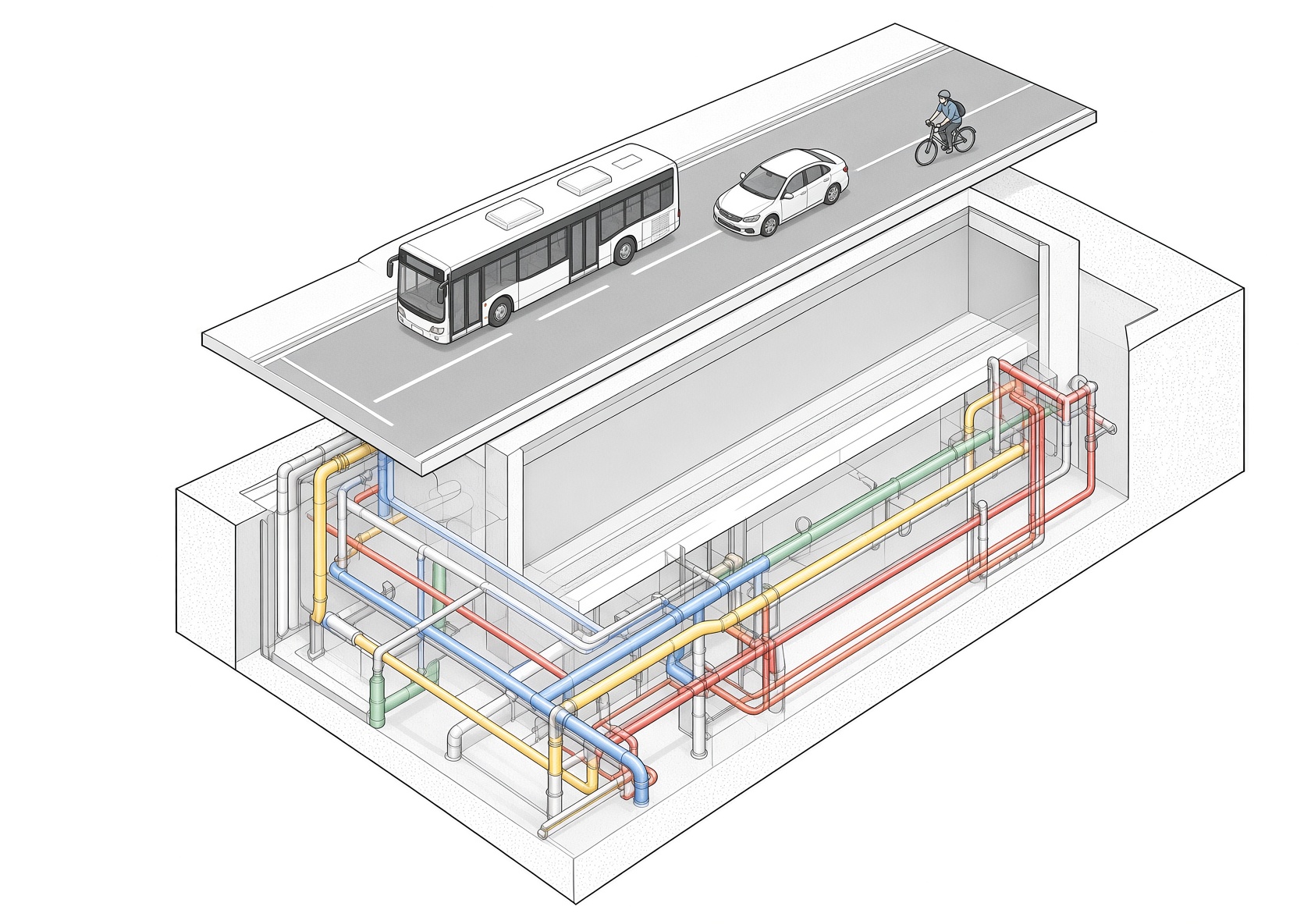
Most people treat road widening as a surface exercise. In an existing urban corridor the surface is the cheap part. The expensive part is the dense, multi-owner utility network already occupying the road reserve, the legal obligation to keep the road functioning while you dig, and the extra width and performance standards demanded by multimodal design. Multimodal projects cost several times more than simple car lane addition for the same length of corridor.
The Real Cost of Widening a Road: Why Multimodal Projects Cost Vastly More
Most people still treat road widening as a surface exercise: more asphalt, new kerbs, fresh paint. That view is wrong and it produces bad policy. In an existing urban corridor the surface is the cheap part. The expensive part is the dense, multi owner utility network already occupying the road reserve, the legal obligation to keep the road functioning while you dig, and the extra width and performance standards demanded by multimodal design. Multimodal projects do not cost a bit more than simple car lane addition. They cost several times more for the same length of corridor. This is engineering, law, and accounting, not ideology.
Surface works are not the driver
A pure pavement overlay can be measured in hundreds of thousands of dollars per kilometre. Adding a single general traffic lane in a constrained urban setting already multiplies that figure because the kerb line moves, drainage is reconstructed, and everything is reinstated to current standards. The moment the kerb moves, the real constraint appears: the underground services that already fill the corridor.
Those services (watermains, wastewater, stormwater, gas, power frequently still overhead, fibre and telecommunications) are owned by different network utility operators. They hold statutory rights under the Utilities Access Act 2010 and the National Code of Practice for Utility Operators' Access to Transport Corridors. When the road authority changes geometry or levels, previously clear assets become conflicts. They must be protected, lowered or relocated. The road project almost always carries the bulk of the cost and the programme risk.
Records are incomplete. Location work still leaves residual unknowns. Every unexpected cable or pipe produces redesign, temporary works, variation claims and delay. Temporary traffic management on a live arterial routinely consumes 25 to 40 percent of total project cost in Auckland. Night works, staged diversions and the need to maintain bus and cycle access compound it. Contaminated soil, heritage features, trees and resource consent conditions under the Resource Management Act and Auckland Unitary Plan add further layers. This is why urban road projects routinely reach tens of millions of dollars per kilometre while greenfield equivalents sit far lower.
Multimodal multiplies every cost driver
A car focused widening can often stay closer to the existing footprint. Multimodal design cannot. Delivering general traffic lanes plus special vehicle or transit lanes, physically separated cycleways on both sides, widened footpaths, and berms capable of accommodating stormwater treatment and canopy trees requires a substantially wider corridor. More of the existing utility belt is disturbed. Design standards for each mode (lane widths, separation, visibility, gradient, accessibility) cannot be freely compromised without failing safety audits or strategic network outcomes. The result is more excavation, more service relocation or upsizing, more complex temporary works, and higher consenting complexity.
Capacity upgrades are frequently required at the same time. Existing pipes sized for yesterday's land use will not serve thousands of new dwellings or the higher runoff from a wider sealed surface. Stormwater must meet current National Environmental Standards and Unitary Plan requirements. Power is often undergrounded. Fibre and gas are relocated or future proofed. The dig once approach (coordinating multiple operators so the road is not dug up repeatedly) is rational, but it forces sequential design, material lead times and construction windows inside one expensive traffic management envelope. It does not make the work cheap; it merely prevents even higher future costs.
Carrington Road is the current demonstration
The Carrington Road Improvements project (approximately 1.6 km between Point Chevalier and Mount Albert) is the clearest recent Auckland illustration. Funded through the Infrastructure Acceleration Fund to support Te Kukūnga Waka (at least 4,000 homes), the works are priced at around $113 million, roughly $70 million per kilometre. Earlier preferred option estimates sat in the $90 to $105 million P50 to P95 range inside a $113 to $120 million envelope.
The scope is not "add lanes and cycle symbols." It includes road widening (primarily western side using the long standing Wairaka Precinct setback), T2 or transit lanes, physically separated cycleways both sides, improved footpaths and crossings, upgraded intersections, a new pedestrian bridge adjacent to the rail overbridge, and major underground services work: stormwater network upgrades with raingardens and swales, gas, fibre, local and transmission watermains (including integration of Watercare's approximately 1 km Ø750 mm concrete lined steel transmission main under a dig once arrangement), and power undergrounding on the western side plus localised eastern sections. A historic wall is being deconstructed, moved and rebuilt as a consent condition.
No public document isolates the utility component as a clean dollar figure. AT treats the major underground services package as an integrated part of the overall cost. Third party works (explicitly including Watercare's transmission main) can be brought inside the AT delivery envelope, but those additional costs are funded by the third party. The core IAF funded scope stays within the funding cap. This arrangement is technically correct (it avoids a second dig) but it concentrates design interfaces, procurement risk and temporary works complexity onto a single construction contract. Drawings show extensive new ducts, chambers, local main replacements and stormwater pipes, with explicit residual risk of unknown or mis located assets. That residual risk is priced into the contingency.
Carrington is not an outlier. It is what a properly scoped multimodal arterial upgrade that also enables significant intensification actually costs once the services, standards and live corridor constraints are confronted. Claims that similar corridors can be delivered for a fraction of that figure without equivalent utility work should be treated with extreme scepticism. The pipes and cables do not disappear because a lower number is preferred.
Legal and process realities that lock the cost in
You cannot simply dig. Corridor Access Requests, Temporary Traffic Management Plans under the Code of Practice for Temporary Traffic Management, and coordination with every affected network utility operator are mandatory. Resource consents cover earthworks, contamination, heritage, trees, noise and duration. Cost allocation under the National Code places most diversionary works on the road project when the geometry change drives the conflict. Inaccurate as builts produce variations that the public purse ultimately absorbs. Programme conditions attached to funding further constrain staging options and raise contingency requirements.
These are not bureaucratic preferences. They are the legal framework that governs shared use of the road corridor. Ignoring them produces either illegal work, repeated future digs, or safety and capacity failures.
Implications
Auckland cannot treat multimodal arterial upgrades as marginally more expensive versions of car lane addition. They are a different class of project. The surface works are visible and politically attractive. The subsurface reality determines the budget and the programme. The lack of transparent public cost attribution between pure transport capacity and essential enabling services is itself a governance weakness. It prevents proper benchmarking and weakens pressure on utility companies for better records and clearer cost sharing.
Until utility records improve, dig once coordination becomes routine rather than exceptional, and design standards are applied with rigorous prioritisation of scarce width, every new multimodal corridor will continue to carry this large, opaque and high risk utilities load. Anyone advocating for more of these projects must own the full cost structure rather than the optimistic surface number. Anyone claiming the costs are simply the result of gold plating or incompetence has not examined the utilities drawings or the temporary traffic management invoices. The numbers are high because the underlying work is high. That is the constraint.
Join the discussion
Community members are invited to add perspective, evidence, or a sharp question. Be specific and keep it civil.
No comments yet. Be the first to weigh in.