The Paper Crossing
Auckland has spent more than $106 million on consultants and contractors for a second Waitematā Harbour crossing and still has nothing to show but paper. Political games do not span water. They only print paper.
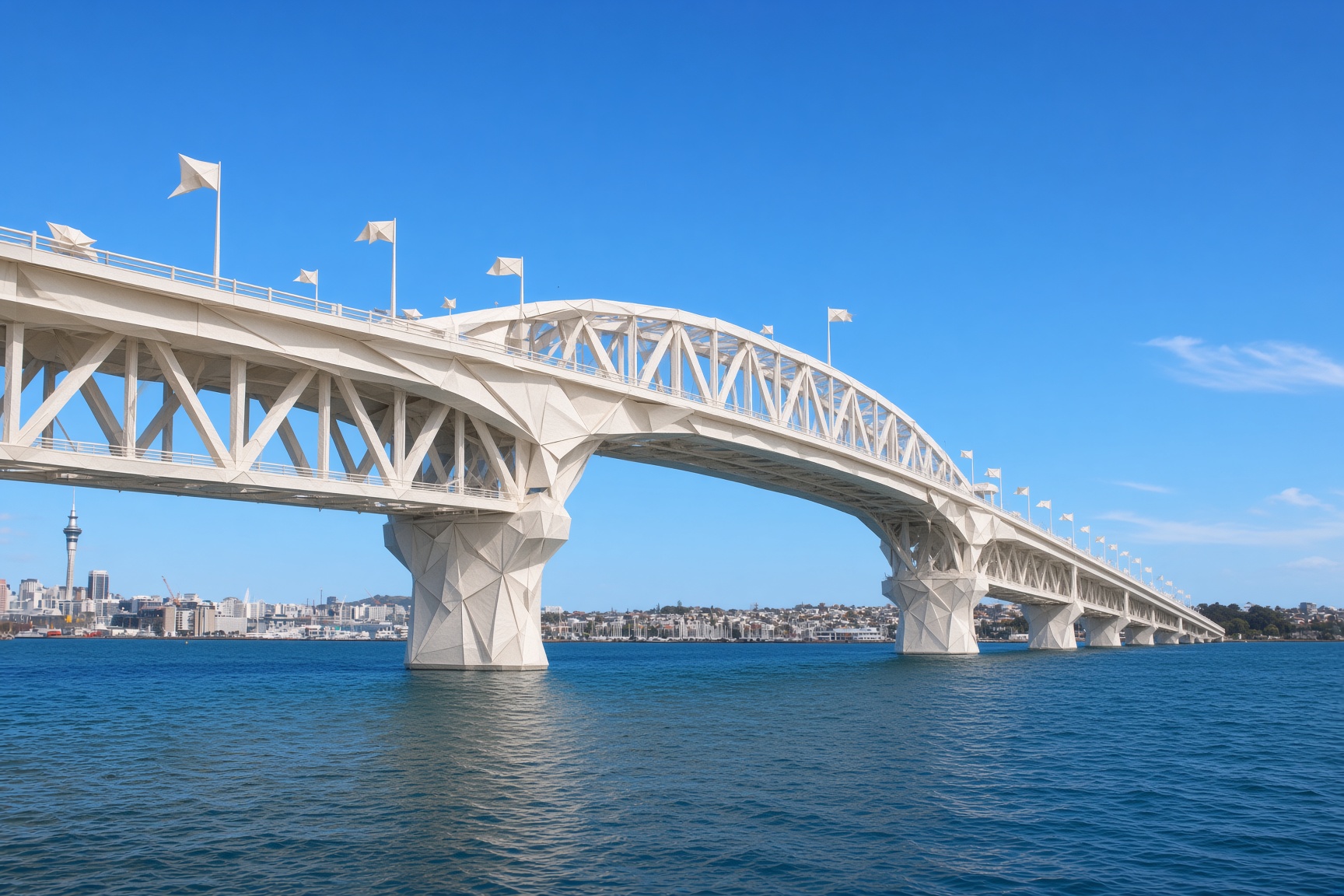
Auckland has spent more than $106 million on consultants and contractors for a second Waitematā Harbour crossing and still has nothing to show but paper. No preferred design locked in. No funding model agreed. No construction start date that anyone believes. Just another round of studies, another set of options, and another deferral past the next election.
This is not an engineering failure. The harbour has not moved. The limitations of the 1959 Auckland Harbour Bridge — capacity, resilience, major renewals — have been documented for decades. What keeps changing is the political preference of the day. Each new government or mayor reopens the file, extracts another business case, and leaves the city with more reports and higher future costs.
Political games do not span water. They only print paper.
The ledger of indecision
Formal studies and business cases run back to the late 1980s. Major work followed in 1997, 2003, 2008–2010, 2019, and the intensive post-2021 phase. Cost estimates have climbed from low single-digit billions (adjusted) to packages in the $20–45 billion range once light-rail tunnels or multimodal ambitions were added.
In 2021 the previous government announced a standalone walking-and-cycling bridge. It was cancelled four months later after $51 million had already been spent on design, consultants and engineering fees, plus nearly half a million dollars on unused waterfront office space. By April 2024 the Indicative Business Case alone had consumed $36.1 million, most of it professional services. Recent geotechnical investigations, including a jack-up barge in the harbour, added further millions. The running total now exceeds $106 million and the project remains firmly in the planning stage.
In May 2026 NZTA completed an investment case that preferred a tunnel. Three months later the government ordered an independently led Detailed Business Case due in 2027 because fundamental questions of cost, financing and delivery were still unanswered. It also agreed to re-examine the Meola Reef alignment — an option studied and discounted repeatedly since the 1970s for environmental damage, poor ground conditions, terrain, community disruption and weaker network performance — provided Auckland Council pays half of the $1 million cost.
Winston Peters calls further reports a gross waste and wants the work put to tender so private consortia carry the risk. Labour criticises the lack of progress while signalling it would continue the new business case. The mayor continues to push his preferred crossing. The Transport Minister seeks bipartisan support because the project will outlast any single government. The pattern never changes: announce, study, re-scope when incentives shift, defer the hard decision.
Vanity is the real construction material
There is superficial agreement that Auckland needs better north-south capacity and resilience. Beyond that sentence the process is captured by competing political brands. One side attaches light-rail tunnels that price the project into the unaffordable. Another insists on pure road capacity or an upgrade of the existing structure. Local government demands its preferred alignment be re-studied. Each actor extracts another cycle of analysis rather than accepting the trade-offs already documented.
New Zealand's legal and institutional framework does not require this. The Land Transport Management Act, Treasury Better Business Case rules, NZTA investment processes, resource management requirements and Cabinet decision-making exist to force evidence, affordability and funding clarity on major projects. Those rules do not mandate endless re-litigation of already-discounted options or the attachment of ideological extras that destroy the benefit-cost ratio. International megaproject experience and Infrastructure Commission advice are consistent: lock scope and governance early or costs and time explode through interfaces, approvals and paralysis.
The current approach inverts that discipline. Scope remains elastic. Decision authority is repeatedly reclaimed by ministers or local politicians. Market-led proposals are floated but not forced to competitive price. Demand-management tools such as time-of-use charging — legally available and far cheaper than new concrete — remain secondary. The predictable result is more consultancy revenue, higher future capital costs through inflation and delay, and continued economic drag on freight, productivity and resilience.
Auckland pays three times
- First, the direct cash already spent on paper with no operational asset delivered.
- Second, the escalating construction bill that every year of indecision produces.
- Third, the ongoing cost of congestion, weight restrictions, planned major renewals (economic disruption from those renewals alone has been estimated in the billions), and the opportunity cost of capital and political bandwidth that could have delivered constrained, fundable upgrades.
Political games never built the original Harbour Bridge. That structure opened in 1959 after a constrained budget forced hard choices. The current generation has the reverse problem: unconstrained process and soft political accountability. Consultants get paid either way. Ratepayers and taxpayers fund the reports. Aucklanders stuck on the bridge absorb the real cost.
What delivery actually requires
- Ruthless scope constraint to what is affordable and high-value now.
- A written cross-party accord on the preferred option family and funding principles before the next electoral cycle.
- An independent senior responsible owner with real delivery authority rather than another open-ended study mandate.
- Early competitive market engagement so private capital prices the risk.
- Pairing any new capacity with demand management so the facility is not immediately congested.
Anything less is continued performance of seriousness while the bill rises. The $106 million already spent is a lower bound. Further political games will only raise it. A bridge is built by deciding, funding, consenting and constructing under the existing statutory framework. Endless re-announcements of further studies are not that process. They are its substitute — the paper crossing.
Join the discussion
Community members are invited to add perspective, evidence, or a sharp question. Be specific and keep it civil.