Auckland’s Port Delusion
Auckland has spent years treating its port like a political football. The recurring cry to “just move it”, most aggressively pushed in recent times by Mayor Wayne Brown in his pre-mayoral advocacy and early term demands for rapid relocation of car and container operations, is a classic example of short-term political theatre dressed up as vision.
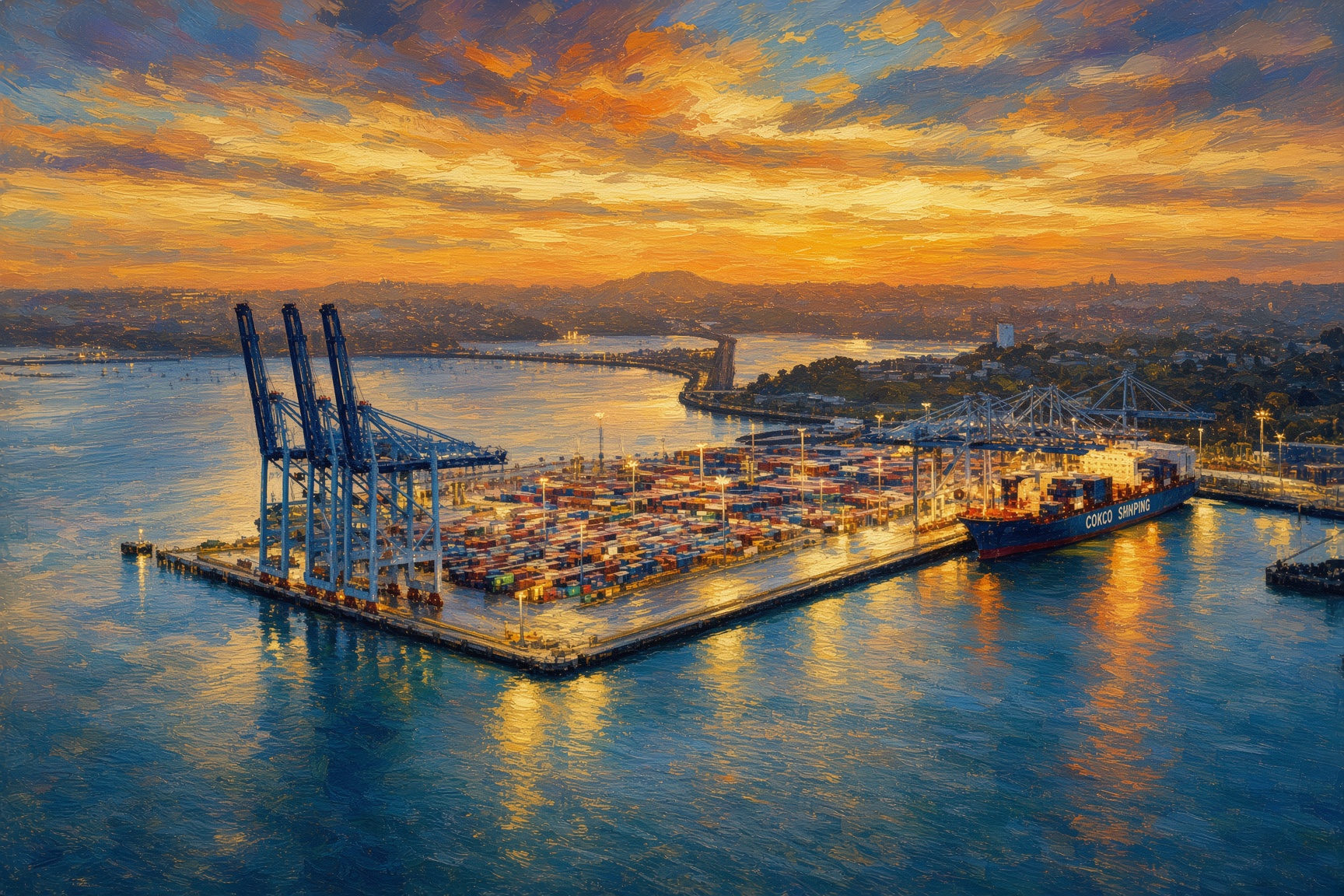
Auckland has spent years treating its port like a political football. The recurring cry to "just move it" — most aggressively pushed in recent times by Mayor Wayne Brown — is short-term political theatre dressed up as vision. It ignores capital reality, shipping economics, supply-chain resilience, and the actual record of successful port cities. The result is uncertainty that freezes investment, distracts from genuine capacity planning, and delivers little beyond headlines.
From deadline to pragmatism
Brown's earlier position was clear and forceful: shift vehicle imports within a year and container activity within a decade or so, preferably north to Northport. That stance aligned with the 2019 Upper North Island Supply Chain work he chaired.
Once in office, the political and commercial arithmetic forced a retreat. The current Plan to Make the Most of Auckland's Port and Waterfront keeps the port operating on the Waitematā for the foreseeable future (30 years-plus under reasonable assumptions), extracts substantially higher returns for ratepayers, consolidates operations, and releases selected central land (Captain Cook and Marsden). That pivot was pragmatic. The original rapid-relocation rhetoric was not.
Successful port cities do not operate on electoral cycles. They treat the port as critical national infrastructure that must be planned, funded, and executed over decades with clear commercial logic.
What successful port cities actually do
The pattern is consistent: successful cities expand or consolidate capacity first, then unlock land. They do not reverse the sequence for political theatre.
- Singapore — executed a multi-decade, fully funded consolidation to the Tuas mega-port. Older city terminals close progressively as capacity comes online. The city benefits because the port works, not because politicians declared victory over industrial activity.
- Rotterdam — expanded seaward with Maasvlakte rather than erasing its industrial core for waterfront cafes. It invested in rail and barge links into Europe's hinterland and treated the port as an economic engine.
- Sydney — its shift of containers to Botany succeeded only because it was long-planned and carefully staged, with alternative capacity already developed. Even then it took decades.
- Melbourne — managed growth through disciplined expansion and inland terminals rather than dramatic central abandonment.
- Hamburg — redeveloped older dockland into HafenCity while simultaneously modernising and retaining a working deep-water port.
Why Auckland's "move it now" impulse fails
Auckland's impulse fails every test those cities pass:
- No ready alternative — there is no site with comparable capacity and market proximity. Northport and Tauranga cannot simply absorb Auckland's full long-term task without massive additional investment.
- Manukau is technically feasible (per 2025 Ministry of Transport papers) but requires multi-billion-dollar capital dredging, ongoing maintenance, higher weather downtime, and complex consenting.
- Dual operation (optimised Waitematā plus Manukau) combined with the long-designated Avondale–Southdown rail corridor could improve geographic matching and reduce isthmus truck movements — but only as a deliberate multi-decade national programme, not a mayoral deadline.
The legal and funding realities
The legal and funding realities are unforgiving. Ports of Auckland is a council-controlled organisation under the Port Companies Act. Major relocation requires:
- central government capital
- resource consents or Fast-track approvals
- Treaty processes
- shipping-line commercial acceptance
Ratepayers cannot fund a new port on political slogans. Creating years of uncertainty simply discourages the very investment needed to stretch the current footprint efficiently.
A better strategy is already visible
A better strategy is already visible in outline:
- Intensify and professionalise the existing port for the next generation.
- Release selected central land for public and commercial use once operations are consolidated.
- Protect and advance strategic rail — especially Avondale–Southdown.
- Develop decision-ready options for additional Upper North Island capacity, whether Manukau, further Northport growth, or rationalisation across the three ports, with realistic timelines and funding pathways.
Extract maximum value and operational performance now. Plan the eventual transition properly. Stop treating a critical piece of national infrastructure as a stage for mayoral signalling.
Cities that treat ports as disposable political assets eventually discover the cost in higher freight prices, congested roads, and lost competitiveness. Cities that treat them as long-term economic engines keep both the jobs and the waterfront. Auckland should choose the latter.
Join the discussion
Community members are invited to add perspective, evidence, or a sharp question. Be specific and keep it civil.