Collaboration Without Capture: Auckland Museum, MOTAT and the Fight for Creative Independence
The Arts, Social, Sports and Community Working Group's two-stage reform is pragmatic — but it must not erase the statutory independence that protects the distinct character of Auckland's museum and cultural institutions.
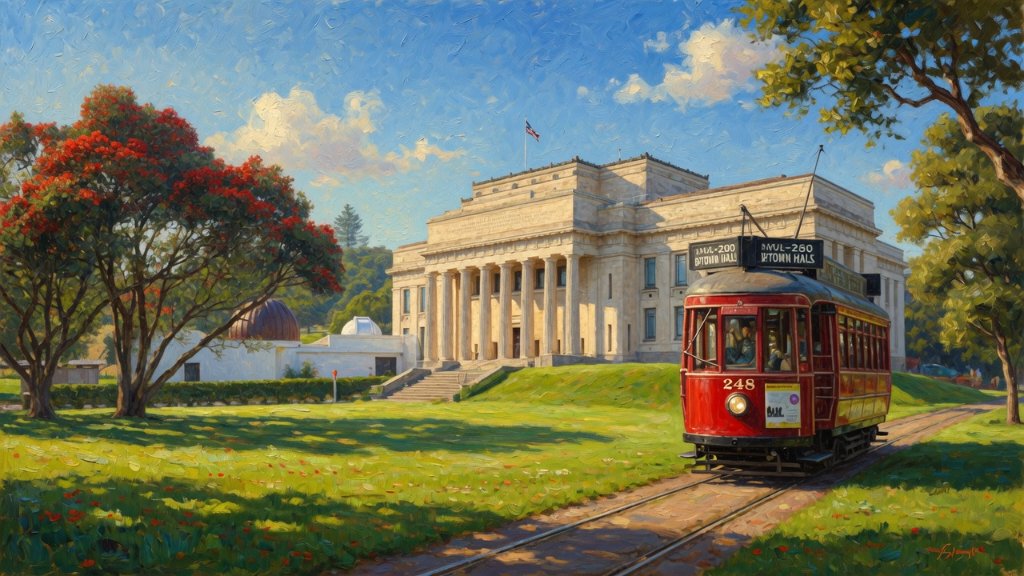
The Arts, Social, Sports and Community Political Working Group, led by Deputy Mayor Desley Simpson, has forced a necessary confrontation with an outdated system. Its two-stage approach — first collaboration through a Cultural Sector Alliance, then legislative reform of the governing Acts — is pragmatic. It recognises that ratepayers fund these institutions heavily and deserve clearer accountability and better value. At the same time it must not be allowed to erase the statutory independence that was deliberately built into the institutions in the first place.
How the current Acts were created and what they protect
The Auckland War Memorial Museum Act 1996 was passed as a local Act to transfer ownership, governance and ongoing funding of the Museum (including its collections and the war memorial function) to an independent Trust Board. The long title is explicit: it exists "to provide for the maintenance, management, development, ownership, and funding of the Auckland War Memorial Museum and its contents." The Board is constituted as a charitable entity. Its composition is deliberately mixed — Council appointees, Auckland Museum Institute appointees, and one from the Taumata-ā-Iwi — so that no single interest dominates. Board members are under a statutory duty to act in the interests of the Museum, not the body that appointed them. Specific objectives include the Museum's role as a war memorial, free public access to the sanctuaries, conservation of heritage, scholarship, education, and the celebration of cultural diversity. The Taumata-ā-Iwi has a formal role reviewing policies on Māori taonga, staffing, display and development. The levy mechanism gives the Board a structured claim on ratepayer funding, subject to limits and process.
The Museum of Transport and Technology Act 2000 is a private Act. Its preamble is equally clear about the problem it was solving: MOTAT needed secure multi-territorial funding because its visitors came from across the region, and the funders needed a formal governance role. Parliament created an independent Board (six Council appointments, four from the MOTAT Society) with ownership of the Museum and its collections. Objectives centre on recording and presenting transport and technology history, conservation of heritage buildings and collections, the spirit of partnership under the Treaty, education, scholarship, innovation, customer focus, and greater financial self-sufficiency. Again, Board members must act in the Museum's interests, not those of their appointing body. The Society is given a continuing statutory role. The levy formula is capped but exists as of right once the annual plan process is followed.
These are not accidents of drafting. Both Acts were designed to place ownership of the collections and the core mission beyond ordinary political control, while still giving ratepayers a funding and governance stake. That is the independence that would be diluted or lost if the institutions are fully absorbed into a Council-controlled organisation or a single new cultural CCO.
Financial advantages that cannot be ignored
The current arrangements are inefficient. Annual levy battles create uncertainty. Capital planning is difficult under rigid statutory formulas. Shared services, coordinated marketing, joint procurement and a coherent Auckland cultural narrative are harder when every entity is structurally separate. Multi-year funding agreements already deliver more certainty for both sides. Closer operational alignment under the Alliance can reduce duplication and improve visitor experience without requiring full structural merger. Legislative reform that replaces the levy with negotiated, LTP-aligned funding and clearer performance expectations is rational. Ratepayers should not be asked to fund institutions they cannot meaningfully hold to account for outcomes.
Those are real advantages. Pretending they do not exist is as unrealistic as pretending the current Acts create no constraints.
The risk of homogeneity of experience
If Council (or a single CCO answering to it) ultimately controls the programming, risk appetite, exhibition style and public voice of the War Memorial Museum, MOTAT, Stardome and the existing Tātaki institutions, the distinct character of each is at risk. A war memorial has a solemn, commemorative purpose that sits awkwardly with pure visitor-number targets. MOTAT's strength is hands-on technology, transport heritage and innovation — a different energy from a traditional museum or a zoo. Science and planetarium experiences at Stardome have their own requirements. When every decision is filtered through the same political and bureaucratic lens, the safe, consensus option tends to win. Distinctive edges get rounded off. The city ends up with a more uniform cultural offer that is easier to manage but less interesting and less true to the original legislative purposes.
Independence is not a romantic absolute. It exists to protect specialist focus, long-term collection care, scholarship, and the ability to take curatorial risks that elected members and risk-averse managers would prefer to avoid. Once the statutory boards, mixed appointment systems, and explicit "act in the institution's interests" duties are removed, those protections become soft policy that can be changed with every new Letter of Expectation.
The practical path
The Working Group's Phase 1 — the Alliance — is the right immediate step. It extracts financial and operational gains while the institutions still sit on their statutory foundations. Phase 2 legislative reform must be approached with precision. Any new framework should retain clear ownership of collections outside general Council asset rules, preserve specialist objectives (especially the war memorial function and MOTAT's technology/heritage focus), maintain meaningful non-Council voices on governance, and keep Māori advisory structures with real teeth. Multi-year funding with transparent performance measures is preferable to both the old rigid levy and pure annual political discretion.
Creative independence and financial discipline are not opposites. The original Acts tried to balance both. The Working Group is correct that the balance has become inefficient. The danger is that reform tips too far toward control and produces a more homogeneous, more manageable, and ultimately less valuable cultural sector. That outcome would be a failure of both creative ambition and long-term public value.
Join the discussion
Community members are invited to add perspective, evidence, or a sharp question. Be specific and keep it civil.